The Chrome Web Store payments system was shut down in phases starting in 2020, with full deprecation by 2021. This shift, driven by the maturation of external payment ecosystems, required developers to migrate to alternatives like Stripe or specialized services. For those affected, the main impacts included reworking licensing and subscription logic, but many reported smoother operations post-migration. Official guidance emphasized building custom migration apps using OAuth 2.0 to fetch user data, though no bulk exports were provided, adding complexity for legacy users.
Top Alternatives for 2026
In 2026, developers have robust choices for monetizing extensions. Addon Pay stands out for its no-backend SDK, handling subscriptions and trials seamlessly across browsers. ExtensionPay offers open-source tools with Stripe integration, ideal for one-time or recurring payments. Direct Stripe use provides maximum customization but requires more coding effort. Other options like Paddle excel in tax handling for international sales, while Gumroad suits simple one-time licenses.
Migration Tips
Start by assessing your current setup: If using the old licensing API, implement a web-based migration tool to port user data. Test integrations in development mode, and communicate changes to users via in-extension prompts. Many developers found success by offering incentives like discounted subscriptions during transitions.
From Legacy to Leverage: Monetizing Browser Extensions in a Post-Chrome Web Store Payments World
In the ever-evolving landscape of browser extensions, the deprecation of Chrome Web Store payments marked a pivotal shift. Announced in September 2020 and fully phased out by 2021, this change forced developers to rethink monetization strategies. What began as a response to ecosystem maturity—Google cited the abundance of third-party payment providers—has, over five years, fostered a more dynamic environment. Today, in 2026, developers benefit from tools that offer greater flexibility, cross-browser support, and innovative features like AI-driven analytics. This article dives deep into the deprecation’s history, developer migration stories, top alternatives, integration code examples, and future trends, all tailored to keep you, the developer, engaged with practical insights and actionable advice.
Historical Context: The Rise and Fall of Built-in Payments
When the Chrome Web Store launched in 2010, integrated payments were a boon for early extension creators. For a 5% fee, developers could handle one-time purchases, in-app items, and subscriptions directly through Google’s system, complete with a licensing API for user validation. This simplicity attracted thousands, but issues like fraudulent extensions and Covid-19 resource strains led to a temporary halt in March 2020. By September, it was permanent: No new paid items, followed by a full shutdown of charges in February 2021.
The timeline was clear but challenging:
- September 21, 2020: Permanent ban on new paid extensions.
- December 1, 2020: End of free trials.
- February 1, 2021: No more charges; subscriptions stopped auto-renewing.
- Post-2021: Licensing API lingered for queries but was slated for eventual removal.
Google’s rationale? The web had matured, with providers like Stripe offering diverse features far beyond what a single store could provide. Yet, for developers, this meant scrambling to migrate without bulk user data exports, leading to custom solutions and potential revenue dips.
Developer Stories: Triumphs and Tribulations in Migration
Migrations weren’t uniform—some developers thrived, others pivoted entirely. Take one veteran from Hacker News: After seven years on the store with tiered pricing, they faced grandfathering dilemmas. Solution? A hybrid approach: Charge current rates but honor old prices via emailed receipts and perpetual coupons. This empathetic tactic retained loyalty but highlighted the lack of seamless tools.
Another Stack Overflow query captured widespread frustration: “How do we build a migration app with OAuth 2.0?” Google’s docs suggested a site-based app to fetch subscriptions, but examples were scarce. A PHP/JavaScript workaround emerged in forums: Use Google’s OAuth library to authenticate, then query the API for licenses. Here’s a simplified snippet for inspiration:
// OAuth setup (using Google APIs Client Library)
gapi.load('client:auth2', () => {
  gapi.client.init({
    clientId: 'YOUR_CLIENT_ID',
    scope: 'https://www.googleapis.com/auth/chromewebstore.readonly'
  }).then(() => {
    // Authenticate user
    gapi.auth2.getAuthInstance().signIn().then(() => {
      // Fetch license
      gapi.client.request({
        path: '/chromewebstore/v1.1/userlicenses/YOUR_EXTENSION_ID'
      }).then(response => {
        console.log('License details:', response.result);
        // Port to your backend (e.g., via fetch to PHP endpoint)
      });
    });
  });
});
On Reddit, one developer shared switching to ExtensionPay: “No backend needed—setup in days, not weeks.” Conversely, a Register commenter lamented low revenues making migration uneconomical, opting to make their extension free while focusing on user goodwill. These anecdotes underscore a key lesson: Early planning and user communication were crucial. In 2026, with mature tools, migrations are rarer, but the stories remind us of resilience in open ecosystems.
Analyzing Alternatives: A Developer-Centric Comparison
In 2026, alternatives abound, emphasizing ease, fees, and features. We evaluated based on integration complexity, cross-browser support, and developer feedback. Here’s a detailed table:
| Service | Key Features | Fees | Supported Browsers | Integration Effort | Pros | Cons | Best For |
|---|---|---|---|---|---|---|---|
| Addon Pay | Open-source SDK for subscriptions/trials; Stripe checkout; license validation; global payments (137+ currencies); no backend required. | 5% per transaction; no monthly fees. | Chrome, Edge, Firefox, Opera, Brave. | Low: Drop-in JS library; test mode for dev. | Unlimited extensions/users; anonymous until payment; easy testing. | Stripe dependency; newer service. | Developers wanting quick, cross-browser setups. |
| ExtensionPay | Open-source SDK; one-time/subscriptions; Stripe integration; cross-browser licensing. | 5% per transaction. | Chrome, Firefox, Edge, etc. | Low: Simple API calls. | Free to start; handles fraud basics. | Relies on Stripe; potential for custom tweaks. | Indie devs monetizing without servers. |
| Stripe Direct | Custom APIs for payments/subscriptions; webhooks for real-time updates. | 2.9% + $0.30 per transaction. | Any via SDK. | High: Requires backend coding. | Highly customizable; global reach; advanced analytics. | Steep learning curve; compliance overhead. | Teams building scalable systems. |
| Paddle | Tax/VAT handling; recurring billing; compliance tools. | 5% + $0.50 per transaction. | Cross-browser via integration. | Medium: SDK with webhooks. | Reduces admin; great for international. | Higher fees for low-volume; less flexible. | Global sellers prioritizing ease. |
| Gumroad | License keys; simple sales; no coding for basics. | 10% flat fee. | Any web-based. | Low: Embed links. | Quick for one-time; no dev needed. | Limited subscriptions; higher fees. | Solo devs with simple models. |
| Braintree (PayPal) | Fraud tools; global payments; PayPal integration. | 2.59% + $0.49 per transaction. | Via SDK. | Medium: API-focused. | Strong security; fund holds options. | Complex for beginners. | Security-conscious enterprises. |
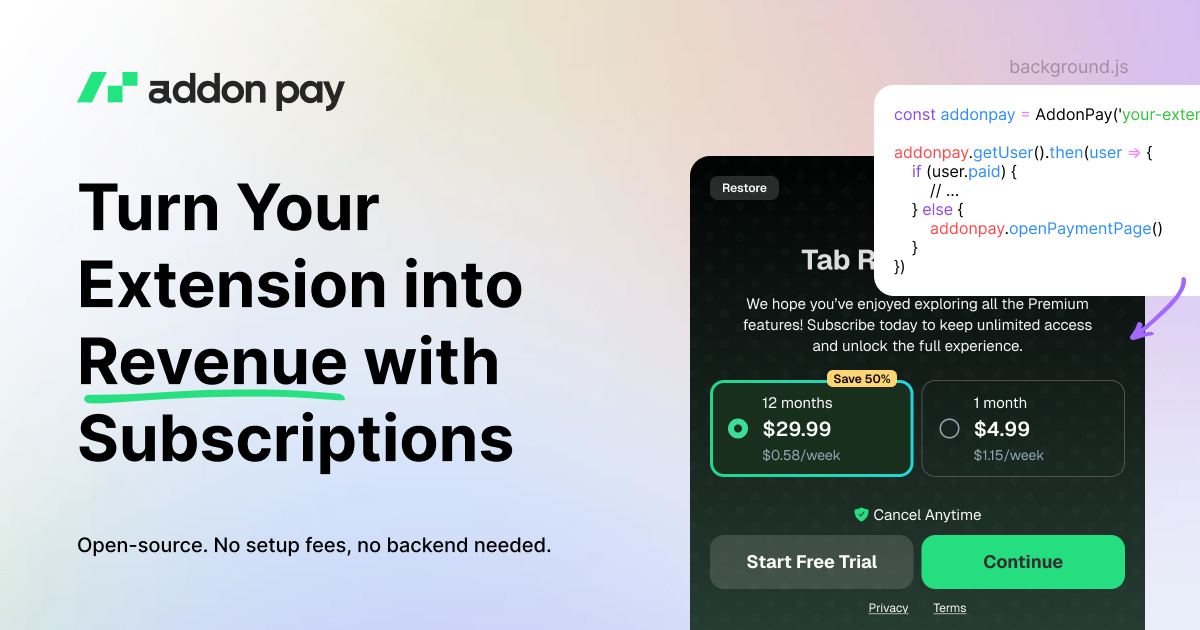
Addon Pay’s testimonials highlight real wins: One dev reported “thousands in recurring revenue” within a year, praising the SDK’s simplicity. For integration, consider Addon Pay’s flow:
// AddonPay.js example
import AddonPay from 'addonpay';

const pay = new AddonPay('YOUR_EXTENSION_ID');

pay.isPaid().then(isPaid => {
  if (!isPaid) {
    pay.showPaymentScreen(); // Triggers Stripe checkout
  } else {
    // Unlock premium features
  }
});

// Handle post-payment webhook (optional for custom logic)
This no-fuss approach contrasts with Stripe’s more verbose setup but offers plug-and-play for time-strapped devs.
Impacts and Best Practices
The deprecation democratized monetization but increased entry barriers for novices. Positive outcomes: Broader browser support and lower fees in some cases. Challenges: Security (client-side SDKs aren’t tamper-proof) and compliance (e.g., taxes). Best practices include A/B testing pricing, using analytics for churn, and focusing on value—honest users pay for great products.
Future Outlook: Trends Shaping Extension Monetization
Looking to 2027+, AI integrations (e.g., predictive pricing) and Web3 payments (crypto via wallets) are emerging. Manifest V3’s evolution may influence SDKs, emphasizing service workers for background payments. Cross-store publishing (Chrome, Firefox Add-ons) will grow, with tools like Addon Pay leading in multi-platform ease. Stay agile: Monitor Chrome Platform Status for deprecations.
In summary, the deprecation was a catalyst for better tools. Whether you’re integrating Addon Pay or building custom, the key is user-centric design—turn payments into seamless experiences, and revenue follows.